

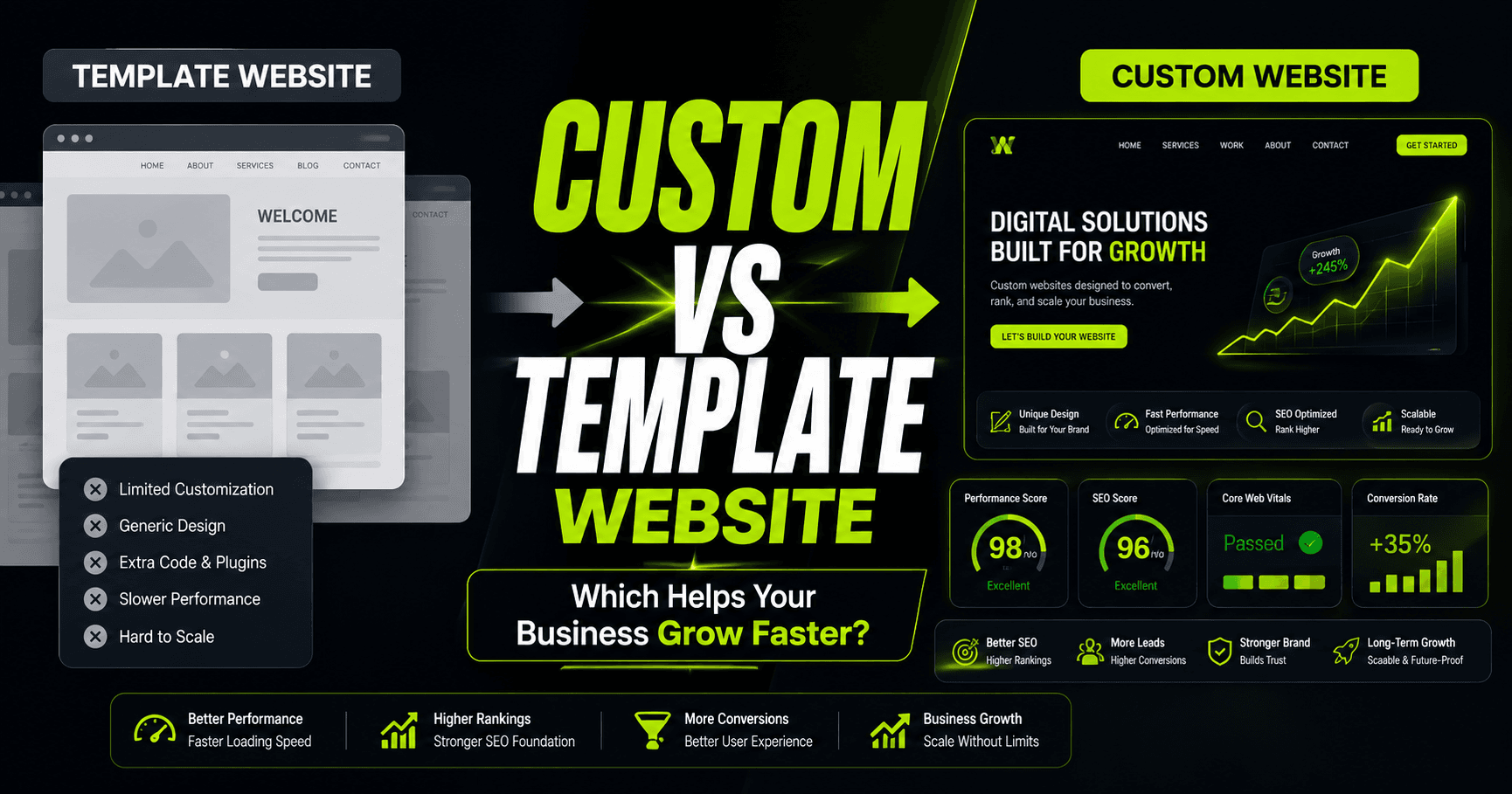
Custom Website vs Template Website: Which Option Helps Your Business Grow Faster?
Quick Answer
If your goal is to launch quickly on a limited budget, a template website is often the fastest option.
If your website is responsible for generating leads, attracting customers, supporting SEO, and helping your business grow over the long term, a custom website is usually the better investment.
The right choice depends on where your business is today and where you want it to be in the next few years.
Quick Decision Guide
Choose a Template Website If:
- You are launching a new business.
- Your budget is limited.
- You need a website online quickly.
- Your website requirements are relatively simple.
- You are testing a business idea or new market.
Choose a Custom Website If:
- Your website is a major source of leads or sales.
- You need advanced functionality.
- You want complete control over branding and user experience.
- SEO and long-term growth are important.
- You plan to scale your business over time.
What Is a Template Website?
A template website is built using a pre-designed layout that can be customized with your content, images, colors, and branding.
Popular website builders and WordPress themes provide ready-made templates that allow businesses to launch quickly without starting from scratch.
Template websites are commonly used for:
- Small business websites
- Personal brands
- Portfolios
- Startup landing pages
- Basic ecommerce stores
Templates reduce development time and upfront costs, making them attractive for businesses that need a website quickly.
However, convenience often comes with limitations.
What Is a Custom Website?
A custom website is designed and developed specifically around your business goals, audience, and processes.
Instead of adapting your business to fit a theme, the website is built to support the way your business actually operates.
Custom websites can include:
- Unique user journeys
- Custom functionality
- Advanced integrations
- Conversion-focused layouts
- Scalable architecture
- Tailored customer experiences
Many businesses eventually move toward custom development after realizing that a generic template no longer supports their growth.
For a deeper look at how tailored development works, see our guide on custom WordPress development.
Custom Website vs Template Website Comparison
| Factor | Custom Website | Template Website |
|---|---|---|
| Initial Cost | Higher | Lower |
| Launch Speed | Longer | Faster |
| Branding | Fully Unique | Limited |
| SEO Flexibility | Excellent | Moderate |
| Scalability | High | Limited |
| Performance | Optimized | Varies by Theme |
| Security Control | Greater | Theme Dependent |
| Custom Features | Unlimited | Restricted |
| Long-Term Growth | Strong | Often Limited |
Which Option Performs Better for SEO?
SEO is one of the biggest differences between custom and template websites.
A custom website gives developers full control over:
- Site architecture
- Internal linking structure
- Schema implementation
- Core Web Vitals
- Page speed optimization
- Mobile experience
- Technical SEO improvements
Template websites can still rank well, especially when built using quality themes. However, many include unnecessary code, scripts, and features that can affect performance.
Businesses investing heavily in organic traffic often choose custom development because it provides greater control over technical SEO and future optimization opportunities.
If website performance is already affecting rankings, you may also want to review common strategies used to speed up WordPress websites.
Which Option Converts More Visitors Into Customers?
Traffic alone does not grow a business.
Conversions do.
A template website is built for general use. It is designed to work for thousands of businesses across different industries.
A custom website is built around a specific audience and specific business goals.
This allows businesses to optimize:
- User journeys
- Lead generation forms
- Calls to action
- Landing pages
- Sales funnels
- Customer experiences
A website designed around customer behavior often converts better than a generic layout.
For businesses that rely on leads, appointments, or online sales, conversion optimization becomes just as important as design.
Branding and Competitive Advantage
Many businesses underestimate the role branding plays in website performance.
Visitors form opinions quickly.
If your website looks similar to dozens of competitors using the same theme, it becomes harder to build trust and stand out.
A custom website allows you to create:
- A unique visual identity
- Consistent brand messaging
- Stronger credibility
- Better customer perception
This is especially important for agencies, professional services, healthcare businesses, legal firms, consultants, and companies operating in competitive markets.
Long-Term Scalability
Most websites change significantly over time.
Businesses often need:
- New landing pages
- Booking systems
- Ecommerce features
- CRM integrations
- Customer portals
- Marketing automation
Template websites can support some growth, but limitations often appear as requirements become more advanced.
Custom websites provide greater flexibility because they are built around future expansion.
This is one reason many businesses eventually invest in a website redesign after outgrowing their original template.
Cost Comparison
One of the biggest reasons businesses choose templates is cost.
Template Website Costs
Typically includes:
- Theme purchase
- Hosting
- Plugins
- Ongoing licenses
Initial costs are lower, but expenses often increase as more functionality is required.
Custom Website Costs
Typically includes:
- Strategy
- Design
- Development
- Testing
- Optimization
The initial investment is higher, but businesses receive a website built specifically around their goals.
The real question is not which option costs less.
The question is which option creates more value over time.
When a Template Website Makes Sense
A template website is often the right choice when:
- You are launching a new business.
- You need a website quickly.
- Budget is your biggest constraint.
- You need only basic functionality.
- You are validating a business concept.
For many startups, a template website can be a practical first step.
When a Custom Website Makes Sense
A custom website is often the better choice when:
- Your website generates revenue.
- SEO is a priority.
- You need custom functionality.
- You operate in a competitive market.
- User experience affects conversions.
- You plan to scale over the next few years.
Businesses that depend on their website as a growth channel usually benefit most from a custom approach.
Signs You Have Outgrown a Template Website
You may have reached the point where a template is holding your business back if:
- Your website feels slow.
- You struggle to make design changes.
- Competitors have stronger online experiences.
- You need features your theme cannot support.
- Your conversion rates remain low.
- SEO improvements are difficult to implement.
- Your brand no longer feels represented by the website.
These signs often indicate that a more tailored solution is needed.
Final Verdict
Both custom websites and template websites have their place.
Templates are excellent for launching quickly and keeping costs low.
Custom websites offer more control, stronger branding, better scalability, and greater flexibility for long-term growth.
If your website is simply an online brochure, a template may be enough.
If your website plays a critical role in lead generation, customer acquisition, and business growth, investing in a custom website is often the smarter long-term decision.
Frequently Asked Questions
Is a custom website better than a template?
Not always. A template works well for simple projects and new businesses. A custom website becomes more valuable when growth, branding, SEO, and scalability matter.
Can a template website rank on Google?
Yes. Many template websites rank successfully. However, custom websites typically offer greater control over technical SEO and performance optimization.
Why are custom websites more expensive?
Custom websites require planning, design, development, testing, and optimization tailored to a specific business rather than using a pre-built layout.
Do custom websites load faster?
In many cases, yes. Custom websites often contain less unnecessary code and can be optimized specifically for performance.
When should I redesign a template website?
Consider a redesign when your website limits growth, lacks required functionality, struggles with performance, or no longer reflects your brand.
Ready to Build a Website That Supports Long-Term Growth?
Whether you need a custom website, a WordPress redesign, or performance improvements, the right website should help your business attract customers, generate leads, and support future growth rather than create limitations.
#websitetemplate #customwebsite #wptechstudio #businessgroth
1 Comment
[…] is one reason we recently explored whether a Custom Website or Template Website is the better choice for long-term business […]